|
|
|
|
|
|
Should your IT Staff run your Telehealth Program?
(Misconception #3)
|
|
|
Hello ,
One of my all-time favorite phrases that I learned over the years in healthcare is "practicing on top of your license". In none of my training on workflow and process design had I ever come across this concept: to design a workflow such that everyone only does those activities, that only they are qualified to do.
Don’t make the sous-chef wash the dishes. Or tell the receptionist in the shop to do the oil change. Or offer the psychiatrist to provide the anesthesia.
As a society, we spent an inordinate amount of time on educating ourselves. We invest in our children tens of thousands of hours of training, which grows increasingly specialized.
But if the workflow dictates that you need to perform work at a level that you are overqualified for (i.e., someone with lesser training could do the job just as well - and potentially even better), the effect is a triple negative.
Not only is such an assignment financially unwise, since you are wasting the time of a highly-skilled resource on performing, given their level, menial tasks and are limiting the amount of time that person can spend on doing what they are best at or most qualified for.
The second, much bigger negative impact is the dissatisfaction that such an assignment brings - either because they have to do tasks they don’t enjoy or don’t have time to do the things they enjoy doing most.
The third impact can be that while that highly qualified person could do the job (say, data entry) they may not be the most proficient at it, further contributing to the dissatisfaction
And this is the segue into one of the points I am making in this week’s article on the 3rd of 6 misconceptions: that the real cost of asking the wrong people to do the job, may be the dissatisfaction
With kind regards,
|
|
|
|
|
|
|
P.P.S.: Do you know a colleague who might enjoy reading this newsletter? Please send them this link to see an archive of past newsletters and an opportunity to subscribe:
|
|
|
|
|
|
|
Should your IT Staff run your Telehealth Program?
(Misconception #3)
|
|
|
"Telehealth is about technology, right? Without technology, there is no "tele"! And we do need a vendor and some software so we can connect patients with physicians. So let’s ask IT to find some software and roll it out."
In my experience, this line of thinking among healthcare or physician leaders has happened many times over the past years and is still going on. As I’ve written about before, the launch of a telehealth service is not a Health IT project, but rather the launch of a new clinical service.
Yet even if people understand that notion, the temptation still seems to be high to assign most of the work to the IT Staff, including the project management of the overall service design, not just of the technology acquisition and deployment.
Misconception #3: Our IT staff is best suited to run our telehealth program.
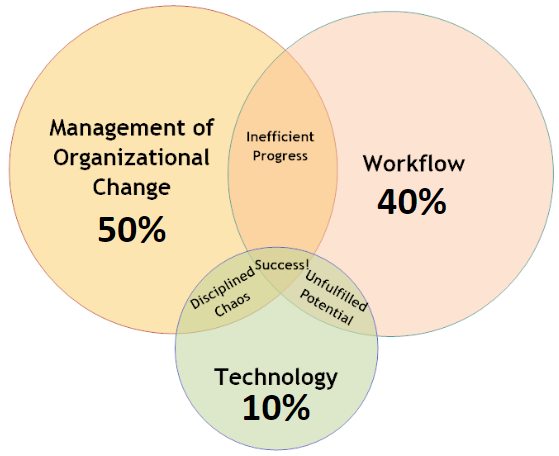
Reality: Technology contributes only 10% to the success of the successful creation of a telehealth service. The key success factors are the design on the right workflow (40%) and conscious organizational change management (50%).
This article is the third of six in my series on the common misconceptions about telehealth. You can find the first two misconceptions here:
- Misconception #1: Telehealth is a Health IT Acquisition and Deployment Project\
- Misconception #2: There is one technology solution for telehealth that everyone will use.
It’s not about the Technology
It has been my repeated experience that well over 90% of the problems with telehealth have nothing to do with the technology itself. Occasionally the technology may be cumbersome to use or problems arise from a lack of bandwidth or cell phone reception. Typically, though, there is not a technology problem that a well-designed process (including training) cannot prevent, circumvent, or fix.
Now, granted, with the telehealth technology of the 1990s and early 2000s that definitely was not the case. Back in the early days, technology was a fickle friend and required a lot of finagling and finessing to get it to work just right.
But for the past 10 years or so, technology really has not been an issue.
Rather, the challenge mostly lies in getting people (including patients) to use the new technology, the new processes, the new service. There is resistance from physicians as it occurs to them as another technology put between them and the patient. There is confusion across all sorts of roles - from the billing staff to the check-in person to the IT help desk staff that didn’t know anything about the new telehealth service.
The secret to telehealth success lies in the joint design of comprehensive workflows that not only handle the "happy day scenario" (when things go the way they are supposed to) but also the times when things go wrong (predictably) or awry (unfathomably).
|
|
|
|
|
Thus the challenge in assigning IT staff to the design and launch of a new telehealth service lies in their lack of experience designing service workflows - especially clinical workflows. Furthermore, oftentimes IT project managers can communicate well with the IT staff and facilities etc. to get the hardware and software installed and configured, but are not as experienced in working with the clinical, administrative and operational staff that are required to design and launch and deploy the new clinical service.
Delegating the ownership of telehealth to the IT department thus creates a triple challenge:
- Fumbling: given that the skills needed to design and launch a new clinical service are outside the realm of IT, any assigned staff will, despite their best efforts, to some extent fumble. While healthcare staff (especially nurses) are highly supportive, the complexities of billing, credentialing, consent, scheduling etc. are beyond the typical experience of an IT staff (with nursing informatics staff being the laudable exception). And this fumbling leads to frustration (especially with physicians) that can prevent the successful roll out of this and future telehealth services.
- Opportunity Cost: Given the inefficiency of fumbling, the extra time spent on getting the telehealth service is time that taken away from the IT staff to do the job that they are very qualified to do.
- Poor job satisfaction: Given the many demands on IT -- our whole healthcare seems to be running on electrons these days -- it can be very frustrating to be given yet another assignment and, more importantly, one that is causing resistance and frustration in the physicians and other staff. This experience leaves IT staff equally frustrated and dissatisfied, with all the repercussions of a low job satisfaction.
So, who IS best suited?
With the premise that telehealth is a clinical service and not a tool or a clinical specialty, the best owner of a new telehealth service is truly all of the staff in the department that is responsible for delivering the telehealth service which includes all of the staff involved in the scheduling, preparation, documentation and billing. Yet this staff is also not adequately prepared in the design and launch, though their involvement as subject matter experts is absolutely critical.
When it comes to the design and launch of a new telehealth service, most healthcare organizations typically do not have the qualified staff experienced in the design of clinical services and the effective management of the organizational change. Some larger organizations have created project management positions and business analysts at the enterprise level (i.e., outside of IT) that are perfectly suited to manage a project like this. Organizations without access to these expertise either need to create this position or look for temporary outside expertise to assist in the launch of a new telehealth service.
Ultimately, of course, the IT staff has to be involved and should be involved as early as possible, but they should not be the ones doing the heavy lifting.
Because you only have one chance to make a first impression and it should be an extraordinary one!
|
|
|
Send me your comments by replying to this email or comment on this article on LinkedIn.
To discuss how you can use telehealth to optimize the delivery of care, contact Christian by phone or text (657-464-3648), email, or video chat.
|
|
|
|
|
This edition of Telehealth Tuesday was sent to _t.e.s.t_@example.com.
Ingenium Consulting Group, Inc., 1173 Bayview Vis, Annapolis, MD 21409, United States
If you no longer wish to receive weekly updates, I'm sorry to see you go. Unsubscribe
|
|
|
|
|